

How I’m Planning My Substack Posts Without Becoming a Content Machine
On writing consistently, using energy wisely, and building work that still leaves room for a life

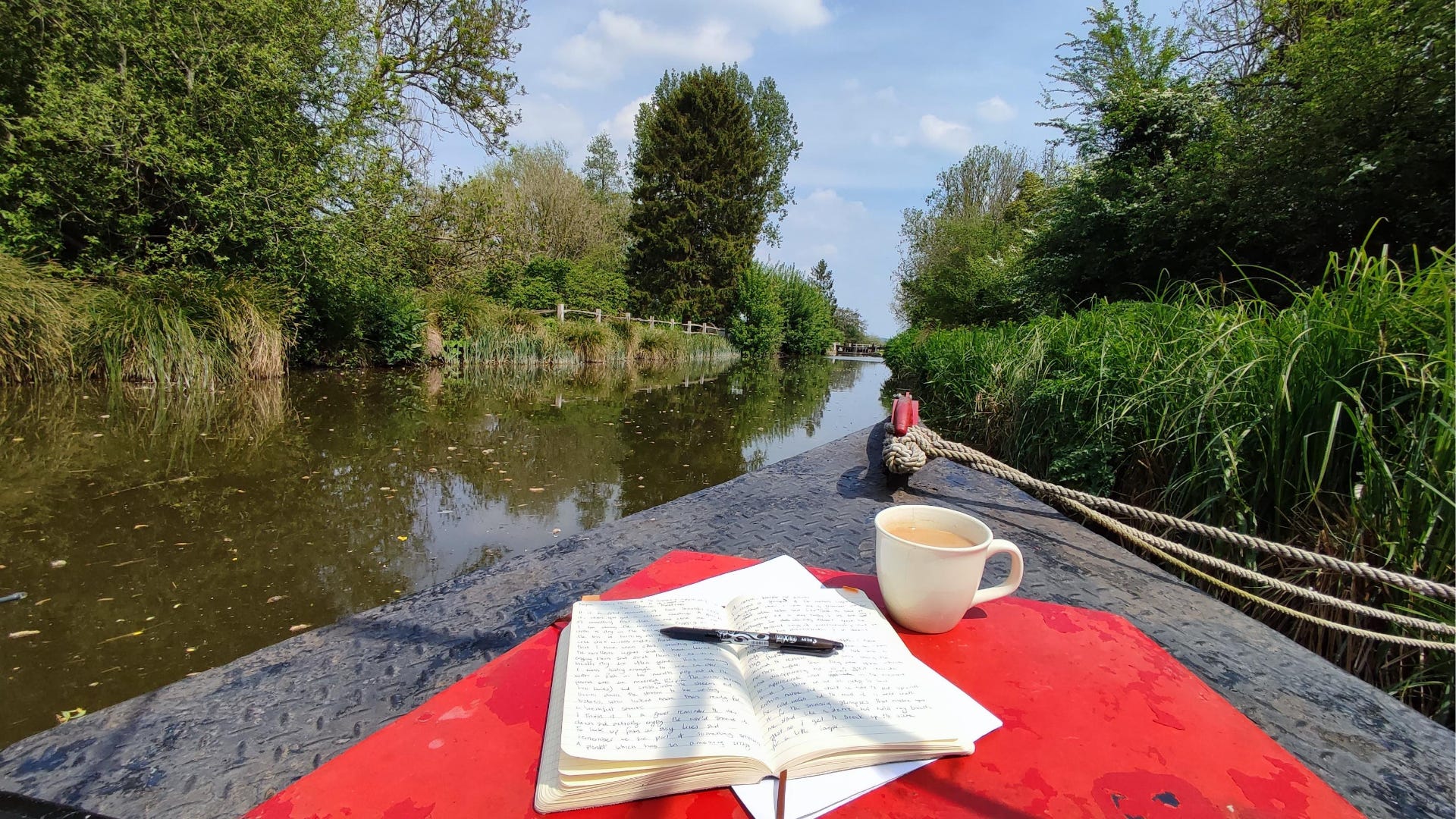
I opened Notion with the very noble intention of planning my work properly. The boat was quiet, my notebook was beside me, and there was a steaming mug of tea within reach while I tried to gather all the loose ends of Simple Life Explorers into something that looked calm and sensible.
I had client work to do, posts to think about, Pinterest pins waiting in the background, Notes I wanted to write, and ideas for future resources sitting half-formed in my head. And the strange thing was, the client work felt easier, which is slightly inconvenient, given that writing is literally my work.
Perhaps this is familiar to you, too. It can be easier to help someone else see the shape of their work than to sit with your own scattered ideas and decide which one deserves your attention first.
When I’m writing for someone else, I can usually see the shape of things more quickly. I can listen for what they mean, find the thread, tidy the message, notice what belongs, and gently move aside what doesn’t.
But when it comes to planning my own work, the edges blur. Simple Life Explorers is not just a business, or a Substack, or a place where I write about slow living on a boat, work, and trying to build something steadier.
It is all of those things, but it is also me trying to live differently in real time. That makes it harder to plan, not because I have nothing to say, but because I am always writing from the middle of it.
And I know I’m not the only one who finds this difficult. It’s one thing to have ideas, and another thing entirely to keep showing up with them in a way that feels steady, useful and still recognisably yours.
This is what eventually led me to create The Simple Substack Post Planner, which I’m making available free to subscribers this week — a printable planner for shaping thoughtful, searchable posts without getting lost in screen-based faffing.
Because I’m not only asking, “What should I write this week?” I’m also asking, “What kind of life am I building? What kind of work belongs inside it? What can I keep showing up for without turning myself into someone I don’t want to become?”
That is where planning starts to feel less like a tidy content calendar and more like a small act of honesty. Because the danger is not only that I will fail to plan, but that I will plan in a way that slowly pulls me away from the life this work was meant to support.
Why planning my own work feels harder
I wrote about this feeling more in I Write for a Living. This Is Still Hard, because it still surprises me sometimes. There is a particular vulnerability in writing for yourself, because you cannot hide behind someone else’s offer, someone else’s message, or someone else’s neat business goal.
You have to decide what you mean. For me, that means writing about boat life and slower living, but also about work, visibility, and building something that can support us without swallowing the life I wanted in the first place.
And I think that is where many of us get stuck. Not because we have nothing to say, but because we have too much.
Too many thoughts, too many little scraps of sentences in notebooks, on phones, and in our heads while washing up, walking, cooking, moving, or waiting for the kettle on the stove. The problem is rarely a lack of ideas.
It’s knowing which idea is ready to become a post. And, more importantly, knowing how to give it enough shape that someone else can find their way into it.
I don’t want Simple Life Explorers to become a machine
There is a version of online work that makes everything feel like a production line. Every thought becomes content, every walk becomes a hook, and every quiet moment becomes something to package, post, repurpose, schedule, optimise, and measure.
I understand why people do it. I understand the practical need for consistency, and I know that if I want Simple Life Explorers to grow through Substack, Pinterest, writing, and slower systems, I can’t just drift along like fallen blossom on the canal, hoping people magically find me.
But I also know what I don’t want. I don’t want to live a slower life only to turn around and squeeze the life out of it for content.
I don’t want to write about peace while secretly feeling frantic behind the scenes. I don’t want to build something that depends on me being constantly available and visible to provide proof that I am doing enough.
That’s not the point of this place. The point is to build something I can stay with, something useful, thoughtful and honest that gives me room to write, earn, share, cook, rest, live, and pay attention — while also helping others think about their own lives, work and choices more gently.
Not perfectly. Not always calmly. But with more intention than panic.
If you are trying to write, share or build something of your own without turning your life into a production line, you’re very welcome to subscribe to Simple Life Explorers. I write about slow living, narrowboat life, quieter work, and the small systems that help meaningful things become possible.
Consistency needs rhythm, not pressure
Living on the boat has taught me a lot about timing, and not in a grand, poetic way. In a very practical, sometimes mildly annoying way.
Work has to fit around movement, moorings, water, batteries, food, weather, muddy towpaths, low winter light, sudden rain, and the kind of days where the simplest job somehow needs three other jobs doing first. I can’t always force the day to behave.
Sometimes we need to move because the mooring time is up. Sometimes the batteries need attention. Sometimes the weather says no, or the best light has gone before I’ve finished making breakfast.
At first, I found this frustrating. I still do sometimes, but I’m beginning to see that this way of living asks for rhythm rather than control.
And perhaps work needs the same. Not a rigid plan that collapses the moment life interrupts it, but a steadier rhythm I can return to when the week starts to feel scattered.
That is what I’m building now. A slower rhythm for Simple Life Explorers, one that helps me write consistently without turning consistency into another form of pressure.
The Notion experiment
I started using Notion because, in theory, it should have been perfect. Everything in one place: post ideas, links, resources, planning pages, titles, paid posts, free posts, all neatly arranged like a calm and capable person had designed my life.
And for a while, I liked the idea of it. But I noticed that the more time I spent inside the system, the less clear my head felt.
I was moving things around, making sections, adjusting layouts, adding ideas, changing categories, and feeling almost productive while not actually moving the work forward in the way I needed. It became another place that sucked time.
And I know that feeling well enough now to be suspicious of it. There is a difference between planning and hiding inside the planning, and I’m very good at recognising it in other people’s businesses.
It’s much more annoying when I recognise it in myself. So I began asking a simpler question: what do I actually need before I write a post?
Not what software do I need, or how many databases, or how many beautiful dashboards. Just what do I need to know before I sit down and write?
Moving more of my thinking offline
The answer, for me, seems to be fewer screens and more paper. A notebook, a printed page, a pen, and a little room around the idea before the internet starts pulling at the edges of it.
I’m trying to move more of my planning offline because it gives me a clearer head. When I plan on paper, the ideas flow, my writing is focused, and I cannot open ten tabs or pretend I’ve done something useful because I’ve rearranged a system.
I’ve written before about when scrolling started to feel heavy, and I think this is part of the same lesson. Living this way has made me more aware of where my energy goes, because energy is not endless for any of us.
If I am constantly on a screen, constantly checking, reading, adjusting, scrolling, planning and re-planning, I’m using up something I actually need for the work itself. And the truth is, I don’t want to give the clearest part of my mind to faffing online, then expect what is left of me to write something honest, useful and alive.
So I’m learning to protect the quieter part of the work. The part that happens before the post exists, when an idea is still soft around the edges and needs a little space before it can become clear.
I have to sit with the idea and ask what the post is really about. Who is it for? What is the reader feeling at the beginning? What might they understand, feel, or trust by the end?
I also need to ask where it fits inside Simple Life Explorers. Is it a quiet life post, a slow work post, a practical resource, a behind-the-scenes note, or a bridge between life and work?
Those questions help me more than a screen does. They give the post enough shape to begin without taking all the life out of it. I don’t want my writing to feel processed. I want it to feel considered.
What slow work means to me now
Slow work doesn’t mean doing nothing. It doesn’t mean having no ambition, no offers, or no desire for the work to grow.
It means building in a way that doesn’t require me to abandon myself every time I want to be consistent. For me, slow work means planning three posts for the week without turning the whole week into a performance.
It means knowing which post is free, which is for paid subscribers, and which resource I’m making next, so I can stop carrying it all around in my head. It means using Pinterest as a gentle discovery path rather than a frantic popularity contest.
It means writing Notes that feel like small, honest moments, not little pieces of bait thrown into the internet. It means making paid resources that are genuinely useful, simple to use, and connected to the life and work I’m actually living.
And it means accepting that my best ideas often need space before they become clear. I wrote more about that in How to Find Your Writing Voice Without Sounding Like Everyone Else, because voice is not something I can force out of myself by staring harder at a screen.
It often appears when I’ve stepped away for a moment. When I am making food, fetching water, or doing something ordinary enough that my mind can finally breathe.
The simple planning pages I needed
This is what led me to create The Simple Substack Post Planner, which I’ll be sharing free with subscribers this week.
Not a complicated content system. Not a promise to become wildly efficient. Just a printable planner that helps me take one idea and give it enough shape to become a useful, thoughtful, searchable post.
I wanted pages I could use before writing, not instead of writing. Something simple enough to keep beside me, but thoughtful enough to help me find the reader, the message, the shape, the useful links, and the gentle next step.
The planner asks me to begin with the reader, not the title. What is she carrying when she arrives at this post? What does she need to feel less alone with? What small shift could this piece offer her? Where does the post belong inside the wider body of work I am building?
Because that is what I need. Not more places to store ideas, but a clearer way to choose one and begin.
And perhaps that’s what many of us need when we are trying to write online without becoming someone we don’t recognise. A small, steady way to return to the work.
Building something I can stay with
I keep coming back to this. I’m not trying to build Simple Life Explorers quickly so I can escape it later; I’m building something I can stay with.
A slower body of work. A useful library. A place where writing, boat life, simple living and meaningful work can sit together without feeling as though they are competing for attention.
That takes planning, but not the kind of planning that presses life flat. The kind that gives life enough room to still be lived.
I think that’s the balance I’m learning now. To be consistent without becoming mechanical, to make useful things without rushing them into existence, to grow without turning every quiet moment into material, and to plan the work without letting the work take over the life it is meant to support.
That feels like the real practice. And it’s one I’m still very much inside.
If you are trying to build something of your own — a body of writing, a small business, a newsletter, a quieter way of working, or simply a life with more room inside it — I hope this gives you permission to think about planning differently. Not as another demand, but as a way of making the work feel possible.
A way of gathering your thoughts before they scatter. A way of saying, gently but clearly, this matters, and I want to give it enough shape to last.
I wrote more about this wider shift in A Slower Way to Live (Without Stepping Away from the World), because I don’t think slow living is about disappearing. I think it’s about learning how to stay present without being consumed.
And perhaps slow work is the same. Not stepping away from ambition, but refusing to build it in a way that leaves no room for a life.
If this is the kind of writing you would like more of, you are very welcome to subscribe to Simple Life Explorers. I write about slow living, narrowboat life, quieter work, and building something meaningful without turning yourself into a machine.
Later this week, I’ll be sharing The Simple Substack Post Planner for free with subscribers. It is the printable planner I created to help shape thoughtful, searchable posts without getting lost in screen-based faffing.
I’m making it free for a while because I want it to help the kind of thoughtful writers, small business owners and reflective creators who are trying to show up more consistently without turning their lives into content machines.
If you would like the planner when it is released, you are very welcome to subscribe to Simple Life Explorers for free. The kettle is on the stove, the pace is gentler here, and the work still matters.
If you would like to support my work, you can buy me a coffee. It helps keep Simple Life Explorers going, and means a great deal when these words have kept you company for a moment.


About the Author
Hello, I’m Rebecca — the writer behind Simple Life Explorers.
I live aboard Arwenack, our narrowboat on the Kennet & Avon Canal, where home moves every two weeks and the seasons are felt through the portholes, the towpath, the water, and the changing light. What began as an unexpected change in how we lived quietly grew into a different way of seeing the world.
By day, I work as a copywriter, helping thoughtful businesses find the words that feel true to them. Here, I write about slow living, simple food, a home that moves, finding your voice, and building quieter ways to work.
Simple Life Explorers is my place to share reflections from life on the water and the gentle process of shaping a life that feels steadier, lighter, and more my own.
At the heart of it all is a simple belief: a quieter life does not mean a smaller life. It can still hold meaningful work, useful ideas, and the steady practice of building something that feels true.